
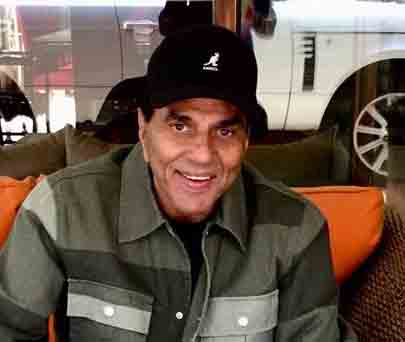
The Bollywood actor Dharmendra Deoi’s death recently has saddened the entire film industry, as well as the movie fans, even though he was not keeping good health for some time. He was to become the nonagenarian by December 25, this year, but his soul departed a month earlier. The yesteryear actor needs no introduction to the film-lovers, as he had a chequered career from 1958 onwards. Array of articles were written about his ability to transform into various roles with renewed vigour, but importantly, he was more a human being than an actor, when it comes to chatting with and assisting the common people, especially with no financial clout or back-ground.
Affectionaly called as Dharam, he never felt that he was a superior actor to his co-artistes. Those were the days the film lovers used to exclaim, “Unlike many other actors, you can go to Dharmendra’s house at any time without fearing a dog barking at you.” Even after attaining the stardom, success did not go to his head, as his famous dialogue in the movie, ‘Guddi’ “Mein tho aaj kal Rajesh Khanna ka naam sunrahahoom”, (Now-a-days, I am hearing the name of Rajesh Khanna) when the heroine Jaya Bahaduri confesses to him that she was her ardent fan and love him to the core, would vouch for it. He even allowed the hero of the film, an unknown face to thrash him on his face in a particular scene, as to prove the movie-watchers that reel-heroes are in no way superior to the real-heroes.
A large number of men were impressed with his macho-appeal. The then renowned stunt-master Shetty said that “of all the heroes only Dharmendra and Vinod Khanna had the guts to confront me in fighting sequences”. He was perhaps right, as in the film, ‘Mera Gaon Mera Desh, a particular scene requires the villain, Vinod Khanna to thrash the hero like anything with his chain. When the hero Dharmendra was seething with pain, Vinod Khanna consoled him with “do not worry, your turn will come”. When Dharamendra gave a fitting rebuff to him in the climax scene, Vinod Khanna said, albeit in a lighter vein, “Oh Dharam Paji, you have outwitted me”.
The popular heroine of 1970s, Hema Malini, said her husband Dharmendra, was one actor, who was considered as a hero in real life too, by many film-hungry fans. Dharmendra was never sick and tired of narrating his past and, as to, how he was struggling to make his career in films, before the prominent film-director, Bimal Roy, who spotted his talent and selected him for the film, ‘Bandini’. The late actor was ever grateful to him and felt that he was relieved once the director, affectionately called as “Bimal Da” in the industry, signalled him with “pass” in the make-up test. Fondly addressed as “Dharam” in the industry, he sought the guidance of the then famous actor, Dev Anand, who encouraged him with a positive comment, “Do not worry, I was struggling like you when I entered the tinselworld and do not lose hour heart”.
Dharmendra, even at the best of his time, did not believe that he was superior to other actors and made it a point of welcoming the newcomers with warmth and action, besides treating his co-artistes with utmost respect. The film, ‘Phool Aur Pathar’ was a turning point in his career, as it became a box-office hit, even though Dharmendra did not have a playboy role in the film and the shooting took place, after averting the misunderstanding he had with the producer-director, O.P. Ralhan in the initial stages. The movie was supposed to project the heroine, Meena Kumari, known for her acting prowess, but Dharam stole the show, as his ‘Shakka’ character, with no inkling for romance and his innocent link with the robbers-gang led by Madan Puri, had impressed the people, more than Meena Kumari, around.
The success of ‘Phool Aur Pathar’ prompted the film producer, S.S. Vasan of Gemini Studios, to remake it as 100th film for the then superstar of Kollywood industry, M.G. Ramachandran with the then popular heroine, Jayalalalithaa. Incidentally the duo ruled the destiny of Tamil Nadu for ten and 15 years respectively, as the former, without any break. Dharmendra never believed in hang-ups, but never bothered for the after-effects of his statements. For instance, he said, in the film, ‘Aye Milan Ki Bela’, the audience wanted him to marry the heroine, ‘Saira Banu’, instead of the then popular hero, Rajendra Kumar, who was addressed as “Jubilee Kumar then, for the constant silver-jubilee hits of his films. Interestingly, Hema Malini, said, in an interview, that Rajendra Kumar was one of her favourite actors and she was happy to cast herself opposite to him in the movie, ‘Gora Aur Kala’. Dharam always appreciated the performance of other actors and once when he visited the then Madras city to watch the shooting of the Tamil film,’Neerum, Nerupum’, a remake of ‘Gora Aur Kola’, he was indeed surprised to observe that the hero, M.G. Ramachandran, was fighting with a real-sword, while confronting the wrong-doers, as normally in Hindi films, the heroes were used to fight only with duplicate-swords. MGR, too, was fond of acting in remaking of Hindi films done by Dharmendra in Tamil. For example, after watching ‘Yadon Ki Bharat’, MGR made it known to the producer and director concerned that he was keen on doing the role of both Vijay Arora and Dharmendra.
Being a versatile actor, Dharmendra never overruled the dictums of the directors, and whenever the situation warranted, he went out of the way to cooperate with the film-units. Dharmendra also wanted to perform everything with distinction. The late popular and immortal singer, peerless Mohammed Rafi, said that he found only Shammi Kapoor and Dharmendra, mouthing his voice to his entire satisfaction and Dharam reciprocated with “Rafi Saheb had sung some memorable songs for me”. Incidentally, it was Rafi who sang his last song for Dharmendra, ‘Tu Kahin Aas Paas hai dost’ from the film ‘Aas paas’ composed by Laxminant-Pyarelal duo. Rafi died the day after recording the song when he bade a good-bye with “mere jaata hoon”, (I am leaving) compared to his usual utterances of “mein aata hoon” (I am coming), which has surprised the composers, as they narrated the sequence, following the demise of Rafi on July 31, 1980. Dharmendra expressed his gratitude in no uncertain terms when he joined the funeral of the melodious singer, along with the music composer, Naushad and the thespian actor, Dilip Kumar. He also regretted similar to Rafi, that the singer did not get a song in the famous film, ‘Sholay’, composed by R.D. Burman, a favourite of the mercurial genius Kishore Kumar’ even though Rafi watched the movie thriced.
Dharam virtually cried after hearing the demise of ‘Jayalalithaa’, by narrating the fond memories of his association with her as a hero, during the making of the film, ‘Izzat’. He excelled in comedy roles, too, with his excellent timing-sense. For instance, in ‘Chupke Chupke, the actor performed the role of an absent-minded assistant professor with a clinical precision. He also did not hesitate to adopt a low-profile in ‘Kajal’, as the major role belonged to the then veteran actor, Raj Kumar, who had penchant for displaying his mannerisms and speaking his dialogues in different ways. In Mamata, Dharam made his presence felt, but realised the importance of the major role played by the heroine ‘Suchitra Sen’ and the veteran, ‘Ashok Kumar’, known as Dadamuni in Bollywood. In Anupama, too, realising the expectations of the director, Hrishikesh Mukherjee, he did not indulge in melodrama. Likewise, he let Hema Malini take the mantle on her shoulder with her double-role in ‘Seetha Aur Geeta’ and in ‘Dream Girl’, besides ensuring that Rajesh Khanna had a major role in ‘Rajput’ and ‘Dharam Aur Quanon’. He never had an insecure feeling and even in ‘Sholay’, he never regretted when comments were made by a section of critics that his other co-actors, Sanjeev Kumar, Amitabh Bacchan and Amjad Khan outwitted him. When Raj Kapoor wanted him to do a guest role in his ambitious film, ‘Mera Naam Joker’, Dharam readily agreed without any favour.
Dharmendra was a go-getter and almost all-heroines were happy and comfortable in casting opposite him. The actor Jayapradha said that Dharam had the habit of calling all heroines as “darling” without attributing any ulterior motivation. However, he became furious when the Janata Dal supremo and the former chief minister of Bihar, Lallu Prasad expressed his desire that he was ready to sacrifice everything, if he gets an opportunity to be with Hema Malini, even showing his inclination to join the BJP, in which she belongs to now. However, Dharam put him in his place with a stern warning, similar to his filmy-like dialogues.
Dharmendra was not cut-out for politics, as was evidenced following his brief association with the BJP. The realisation had dawned on him that cesspool of politics would not suit him, similar to the claim made by his co-star Amitabh Bacchan, as they would wish to remember the song, “Ye Dosti Ham Nahin Chodenge’ from the blockbuster, ‘Sholay’, rather than confronting the mudslinging on the political front. However, he went out of the way to assist his better-half to successfully sail around the political arena, as Hema Malini has been on the winning wicket thrice in a row from the Mathura constituency in Uttar Pradesh.
Dharmendra, however, did not let his passion for acting die, as he continued to perform till his death, contrary to Hema Malini, who at one time regretted about her dwindling market in an interview to a weekly, “My husband Dharmendra is not willing to act with me anymore, Rajesh Khanna hardly gets films now-a-days. Jitendra is roaming with younger heroines in south.” The well-known film critic, Saibal Chatterjee aptly summed up about Dharmendra in THE HINDU daily that Dharmendra was a media-shy and stead-fastly refused to grant interviews to the journalists in the initial stages of his career. However, he could have avoided the controversy that landed him prison when he attempted to manhandle the then Star and Style editor, ‘Deviyani Choubal’, who ran for her life when he chased him like a sprinter, despite the attempts made by Dilip Kumar to stop him, besides beating the now-defunct Blitz correspondent, ‘Krishna’, black and blue for writing about his affair with Hema Malini. Hema’s Mother, Jaya Chakravarty, even offered bouquet to the wounded scribe. Dharmendra is reported to have prevented the Hema’s marriage with another co-star, Jitendra, with Hema posing a question to her mother, “Ippa Enna Pandrathu” (What should we do now).
In the late 1990s, Dharmendra turned to supporting roles, beginning with ‘Pyar Kiya to Darna Kiya’ a 1998-release. His last film, ‘Ikkis, directed by Sriram Raghavan, is scheduled to release on December 25, this year. Dharmendra has acted in more than 300 films, in a career-spanning for more than six-decades. No other actor could influence the course of his stardon the way Dharmendra did. He was an ardent fan of Dilip Kumar and used to play badminton with him, besides visiting his house immediately after the thespain expired in 2021, to express his condolences to his bereaved wife, Saira Banu and other family members. Many actors would come and go, but Dharmendra would be remembered forever in the tinsel world. He was immensely pleased when his farm house had a record production than the success of his films. He sincerely regretted for consuming too much of alcohol when he was at his prime, similar to the Kollywood superstar, Rajinikanth.
K.V. Venugopal , Chennai.