
We began our sixth day from our hotel at Kaziranga forest at 8 am to Cherapunji in Shillong. Our tour operator cautioned us that the ride would take about nine hours covering a distance of about 250 kms. He also felt, closer to Shillong the heavy traffic would slow us down.
The vehicle stopped for a short while for us to pick up some tea packets as local souvenirs. The shop keeper on seeing the volume, presented our tour leader with a cap bearing the shop name and emblem. He in turn gifted it to our tour guide from Agartala.
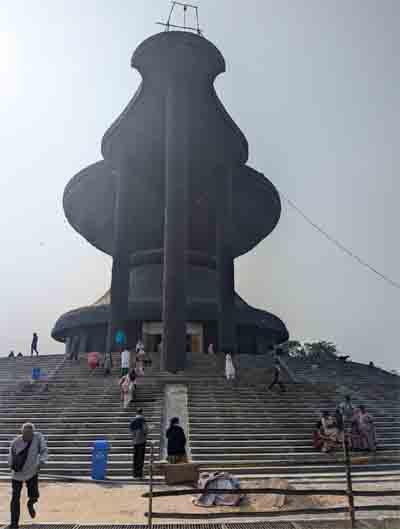
We drove across a well laid two lane Highway. The speed was regulated due to speed breakers at specific points, identified as animal corridors and to allow traffic coming from the opposite direction. The driver also had to navigate through slopes and hair pin bends. Wherever the roads straightened out, the driver picked up speed. After traversing about 120 kms, the driver took a right turn and a few minutes later he slowed down to take a left turn. There were excited voices all around in our van. I looked out of the window to view the towering Siva Lingam before us. We had reached the Maha Mrityunjay Temple, the structured on a Shiva Linga. My eyes slowly rose up skyward to fully drink in the 126 feet structural engineering marvel before me, being the world’s largest Shiva Linga. My joy knew no bounds. Even as our vans came to a halt we were out in a trice and walked briskly towards the entrance, where we removed our footwear.
We walked across the well laid out pathway, with three water tanks on either side of the pathway, with colourful fishes moving serenely in the still waters of the tank, along with a few water turtles. We then alighted about thirty steps and it led us to the left side of the circular structure on the northern side. A wooden door opened on the right and we entered the sanctum sanctorum. We stood there in a trance. At the centre of the circular hall is structured the main sanctum with four main square pillars at a distance of about thirty feet on each side at the perimeter, in my estimation. The pillars are closed with a circular tabletop structure, about three feet high from the ground and of about a foot in width. I found an opening of about two inches below the tabletop and on the tabletop was neatly written “For Donations”. This is very unique and appealed to me.
On the southern side there is an opening for the priests to enter the sanctorum. Behind the closed eastern door, the pooja instruments are neatly arranged against the wall.
The Lingam is placed at the center of the hall with an overhang horizontal circular plate and a channel behind the lingam, for Abhishek. Next to the Lingam is the Nandhi with a snake and behind the Lingam is a trishul. Near the Nandhi, we noticed a lamp in a box.
Close to the Lingam were placed lighted lamps with the other pooja paraphernalia.The ceiling wears an ornamental look with a lotus over the lingam on which is inscribed “ohm” and trishul.
We realised that we were just in time when the archana started.
After the initial formalities to start the pooja, a poojari picked up a plate with six compartments, lit the five compartments, leaving the one compartment at the rear, free. As the head priest started chanting the Hymns, with the slow beat of three drummers accompanied by the jangle of the cymbals, one of the priests performed the arthi to match the music. As the beat of the drums and cymbals increased, the priest also increased the freq
uency of the arthi across the Lingam. As the rhythmic beat raised to a high pitch, we had an inner feeling of ecstasy and tranquility, transforming us into a moment of nothingness with a calming effect.
On completion of a part of the Hymns, the priest placed the Arthi plate down. He then took another Arthi spoon and lighted a single lamp. Three more priests joined the seva and as the head priest continued with fresh Hymns, the other formalities were carried out by the other priests, the arthi was also being performed simultaneously. At the conclusion of the pooja, all the priests prostrated in front of the Lingam and the assembled devotees followed suit. One of the priests went round sprinkling the holy water on the bowed heads of the devotees. Another priest applied sandle paste on the forehead and one more started distributing the plantain as prasad.
I was curious to learn more about the instruments used but was told it is a restricted area. So we moved to the exit. We climbed down a flight of stairs on the western side which led us to the Durga shrine, where a priest blessed us by applying kunkum on our forehead and with prasad.
We thanked our tour guides for handling the temple yatra with quiet efficiency, which ensured we had a very blessed darshan and headed for our bus with fulfillment and renewed energy.
Inputs
# Mrutyunjay : Means “Conqueror of Death” or ” Victorious on Death”. This Sanskrit name is an epithet of Lord Shiva and symbolises immortality and strength.
# Nagaon : Means “new village” derived from the Assamese word “na” (new) and “gaon” (village). Nagaon. The locals say it is a cluster of nine villages.
# The site is believed to be where the Mahamrityunjaya Mantra was composed 1000s of years ago.
# The construction of the temple was completed on Feb.’21.
Inputs Source: Online
S. Sundar Rajan, Mobile 98410 35185