
Over the years, I have taken a fancy for the moon, so much so, I have made it a habit to bond with the moon, especially without fail, on ‘Moonram perai’ (the third day after new moon – Ammavasai) and in the evening of the Full Moon, admiring the resplendent Eastern sky, spell bound by its changing colours from red to orange to silver as the timeless time progresses into the night.
The September Full Moon, christened the Harvest Full Moon, is bright for most part of the period because of its proximity to the Vernal equinox. This helps the farmers to harvest their crops even long after sunset. This time I was overawed by its brightness and as usual shared the photos I clicked with my select moon lovers in my group, referred to as Moonatics.
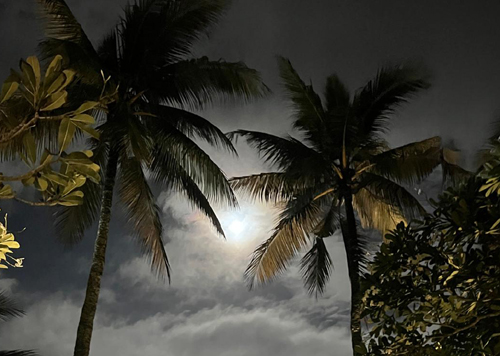
One of the members in this group, who is the co writer of this article, was holidaying in Sri Lanka and on my request, she shared pictures of the Full Moon from there and also shared her experience. It was exquisite and turned out to be in black and white, which was reminiscint of the decades back black and white film roll days.
QUOTE:
I was in Colombo, Sri Lanka, taking an evening stroll around the hotel when I felt a few raindrops on my hand and looked up. The full moon in the night sky made me stop in my tracks. I was completely transfixed.
The sky was deep and dramatic, almost charcoal-black, while the moon shone softly from behind drifting clouds, creating a luminous halo around it. Tall coconut palms rose on either side, their long fronds appearing as silhouettes against the moonlit sky. Warm lights from the surroundings gently 9touched the trunks and leaves, adding another layer of beauty to the scene. It felt as though the whole landscape had paused to admire the moon.
What made the moment even more special was knowing what the full moon represents in Sri Lanka. Each full moon day, known as Poya Day, is a public holiday and an important day of Buddhist observance. It is traditionally a day for prayer, meditation, practising generosity, visiting temples and reflecting on one’s life. It is also a dry day, when the sale of alcohol is prohibited, allowing the day to retain its quiet, devotional character.
Standing there beneath the vast sky, I could understand why the full moon holds such a special place in Sri Lankan life. It was not merely a beautiful moonlit night; it seemed to carry a sense of peace, reverence and stillness.
UNQUOTE:
The majority of the population in Sri Lanka follow Buddhism and the Full Moon has a phenomenal spiritual significance in Buddhism, as major events in the life of Gautama Buddha, like, his birth, enlightment under the Bodhi Tree and his final passing into Parinivarna, all occurred on Full Moon Day.
The September Full Moon in Sr Lanka is called Binara Full Moon Poya Day, which is the sixth month of the Sinhalese calendar and commemorates the historical establishment of the Bhikkhuni Sanga (the order of the nuns of Gautama Buddha)
The word Poya has its roots from the Sanskrit and Pali word Uposatha which means a “fast day”.
There are twelve (sometimes thirteen) Poya days in a year and each has a specific name and marks a major milestone in Buddhism.
On each Poya day, devotional Buddhists, dressed in white , visit the local temples to meditate, pray, offer flowers and observe the Eight Precepts (Ata Sil), which are a set of temporary moral guidelines and renunciation practices observed by lay practioners on holy days, mass days, (Uposatha) or during retreat
The individuals, on these days refrain from:
- taking life
- taking what is not given
- any sexual activity
- incorrect speech
- intoxicants
- eating at wrong time
- entertainment
- personal adornment and luxurious beds.
My school mate, a native of Sri Lanka, provided some insights on the major events on Poja days.
He started off very enthusiastically, stating that the first thing we check when the government releases the next year calendar is when are the poya days and how many long weekends are there.
He then started with Vesak (May), which is the holiest day in the Buddhist calendar when the country is colourfully lit up with lanterns, colourful thoranams decorated with art, dipicting stories of the Buddah’s life, lit up with incredibly intricate lighting are erected across the country, which signify Buddha’s Enlightenment. Dhansals (Annadhanam stalls) spring up everywhere to feed the thousands who go from place to place soaking in the atmosphere, which is more like a carnival than a religious festival.
Poson (June) signifies the introduction of Buddhism to Sri Lanka and the main religious activities are centred around Mihintale near Anuradhapura. The celebrations are mainly religion centred with chanting of pirith (means “protection” or “safeguard” in Theravada Buddhism ) and sermons (bana). Pirith refers to the traditional Buddhist of chanting or reciting specific verses and discourses (suttas) spoken by the Buddha.
Esala (July) is highlighted by the world famous Esala Perehera (a ten day pagent), where elaborately caparisoned and lit up elephants parade the streets of Kandy. The hicghlight of this event is, the casket, carrying the replica of the Sacred Tooth Relic, housed at the Temple of the Sacred Tooth Relic (Sri Dalada Maligawa) in Kandy is taken in procession, atop the temple tusker. Over fifty elephants brought from all across the country join the procession.
To make my travel relevant and interesting, I have recently started on
“theme based tour” and Sri Lanka is now in my bucket list.
Sundar Rajan and Sathya Venkatesh