
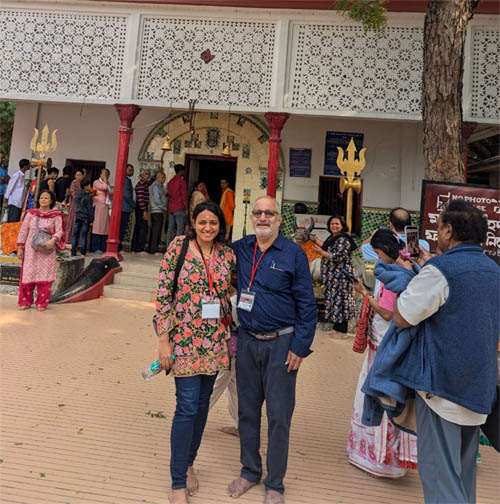
This temple is about twenty two kilometres from the Gauhati Airport. It is located near Baruah Souk in North Gauhati on the Bhasmakuta or Bhasmachala (a place of ashes) hills, on the smallest inhabited river water island, (measuring 0.11 sq kms.), in the world. It is an inselberg (1)on the Brahmaputra river and is dedicated to Lord Siva. Umananda signifies the one who is blissful to Uma or Goddess Parvathi. This island was named as Peacock island by a Britisher because the shape of the island is identical to the shape of the peacock feathers. It is also referred to as Urvashi(2) island. It is the belief that it was a mythological creation of Lord Siva (3) and he resided here in the form of Bhagananda. (4)
The traffic on the road was quite heavy and it was with some difficulty that we found parking spaces for our vehicles.
The approach to the temple is by ferry or ropeway. We opted for the ferry as we wanted to travel as a group. We came to know that the ropeway, connecting the opposite banks of the Brahmaputra river, measuring about 1.80 kms., is the longest river water ropeway in India.
We had to negotiate tricky terrain from the main road that sloped to the ferry. The muddy steps carved out of sand were not uniformly laid out and at times were slippery. As a safeguard measure, wooden structures were planted for support along the path to the ferry. On reaching the waters, we were ushered through a stationery ferry, bearing the sign (Jolporee Pontun – meaning “ferry” in the broader sense) and we then boarded our ferry.
The ride on the ferry was very smooth, scenic, enchanting and breathtaking, with the rhythmic chiming of the water. Some of us were so excited and we kept moving across the deck to click pictures from vantage locations on the ferry, which at times was fascinating. Now and then the ferryman kept blowing the horn but little did we realise that in our enthusiasm, we were hiding his view forward. As realisation dawned, we quickly moved out. After an enjoyable twenty minute ride, we reached the shores of the island. We alighted from the ferry but again had to traverse very carefully, the muddy track leading to the well laid out steps. En route, there was a cluster of shops, where we left our footwear and reached the temple entrance, after climbing about 150 steps from the base.
We were informed by our guides that the temple was built in 1694 by the Ahom dynasty’s Bar Pukan Gurh Ganya Handique on the order of King Gadadhar Singha.
A major earthquake in 1897 damaged the temple extensively and it was rebuilt by a wealthy merchant with a unique blend of Shaivism and Vaishnavi architectural style.
Lord Vishnu and Lord Shiva are the main deities along with exquisite engravings of Hindu deities and motifs.
The duty guards are placed at key locations and regulate the pilgrims very effortlessly, with due care.
On entering the temple, we had a very good darshan of Lord Vishnu, with the priest offering Aarthi. On completing a pradarshan, the path led to a flight of steps behind Lord Vishnu where we took the blessings of Lord Shiva from the priest.
We spent some time in the precints of the temple, where there were good seating arrangements. We then climbed a few steps down to have a darshan of Lord Anjaneya and walked down to board our ferry for our return to the city.
I noticed that a pillar has been raised near the shore and
on enquiry I was told that it indicated the danger mark in the river water rising above this level. One factor that was gnawing at me was the impact to the temple in case of the rising of the waters of the Brahmaputra river on account of the floods. The guides reassured me that since the temple is on the hillock, the flood waters do not reach the temple.
Little did I anticipate that I will be blessed with having the darshan of the Lord Vishnu and Shiva in a temple on the smallest river water island in the world. It turned out to be a memorable, enriching, unbelievable and surrealistic experience, which I am sure to carry in my heart for ever.
Footnotes:
- Inselberg
An isolated rock or hill that arises abruptly from the surrounding plane.
2.Urvashi island
It is said that Goddess Urvashi brought Amrit or nectar here for the enjoyment of Kamakya and hence the island is also called Urvashi island.
- Legend has it that when Lord Shiva was in deep meditation, Kamadevi interrupted Lord Shiva who got infuriated and burnt Kamadevi to ashes.
- Bhagananda
Mythological significance to Lord Shiva.
PS –
- This is the smallest river water island in the world and2. This is also the longest river water ropeway in India.
Sundar Rajan